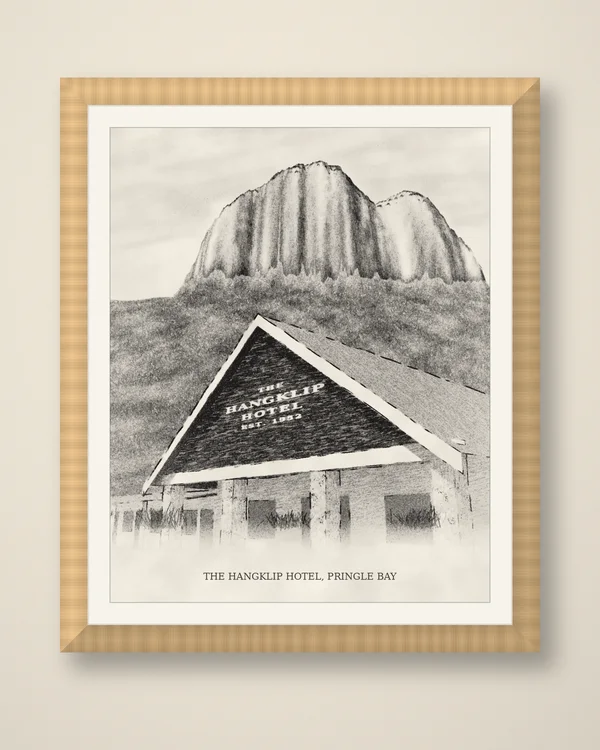
Hangklip: a mountain, a lighthouse and a hotel.
We didn't start with a business plan. We started with a lathe, an obsession with lighthouses, a shared love of wood, and the simple joy of making something by hand.
The Hangklip Story
Hangklip is three things to us: the mountain, the lighthouse and the hotel. Together, they made this story.
It started with a request from Thereza, a close family friend. She knew we were on our way to a lighthouse, and asked us to look for a salt and pepper grinder of the lighthouse itself.
That one request started it all: why not a mill for every lighthouse on our coast?

My goal is to make South African lighthouses live on in people’s homes. If my passion for the Lighthouse Mill project only makes people pause at a lighthouse, and for a few seconds think of its history, its splendour and the lives it has saved, that alone will make me content.
Ken, pharophile in the making
The Soul is in the Wood
The first lighthouses burned wood to make their light. Ours still do, in a way.
Every lighthouse gets the timber it deserves. Hard maple, padauk, imbuia, walnut: wood worthy of a collection. Our Classic mills are turned from solid wood, then hand painted.
Beyond the Classics, every mill is designed one lighthouse at a time. Where a tower allows, we laminate different woods before turning, so the bands are the timber itself: dark imbuia, red padauk, pale maple. Some mills carry inlays. Where a tower will not take a laminate, a spiral for one, hand painted detail tells its story.
So every design is unique, and priced for what it takes to make. The value lies in its scarcity, and in the beauty of that one lighthouse.

Signed by the Maker and the Artist
Every lighthouse is turned by a maker and hand painted by an artist. The artist signs the mill, and both put their names to its Papers of Provenance. Even the lattice of our steel towers is painted by hand, strut by strut, straight onto the turned wood.
We keep the colour thin on purpose, so the grain glows through. The finish is breathable, water repellent, and gives colour and protection in one coat.
Food safe, 0% VOCs, UV and mould resistant.

To Guide You Home
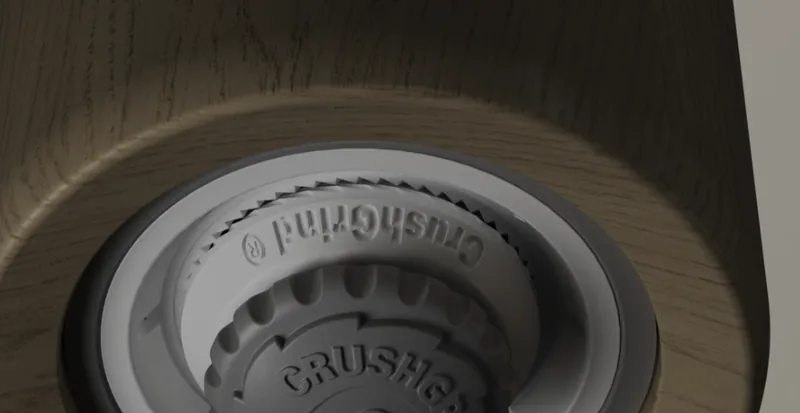
It feels right that a nation of Viking seafarers, who trusted the stars and read the sea, is part of this story. That same spirit of navigation is what a lighthouse is. Inside every mill, unseen but felt with every turn, is a Danish made CrushGrind® mechanism: smooth, steady and reliable.
Metals made for the Sea
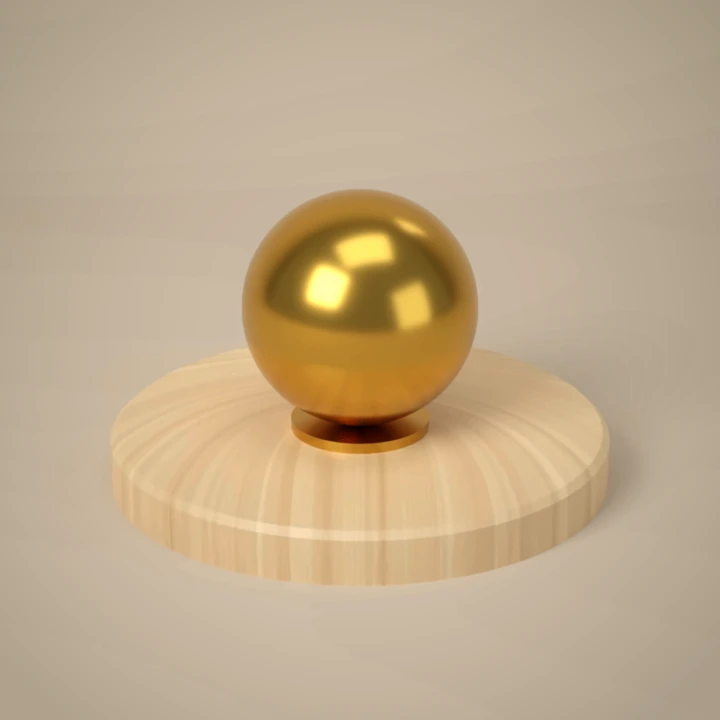
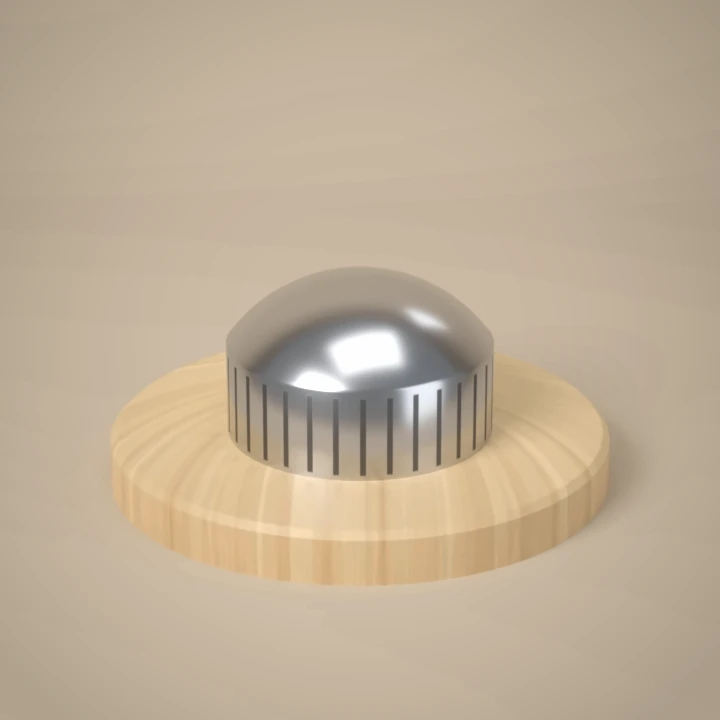
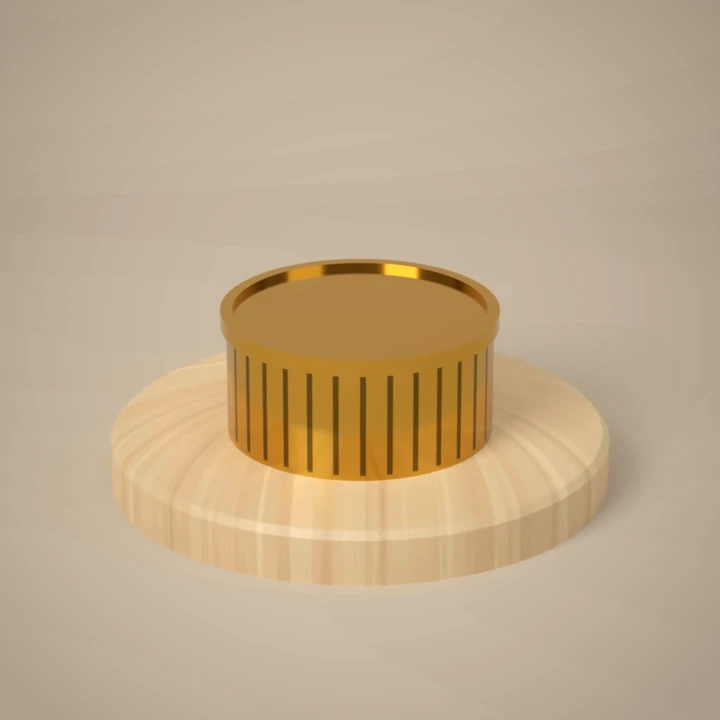
We top each mill with tomorrow in mind. Cool stainless steel loves Salt, warm brass loves Pepper. The knobs are interchangeable: your pairing, your patina.
Papers of Provenance
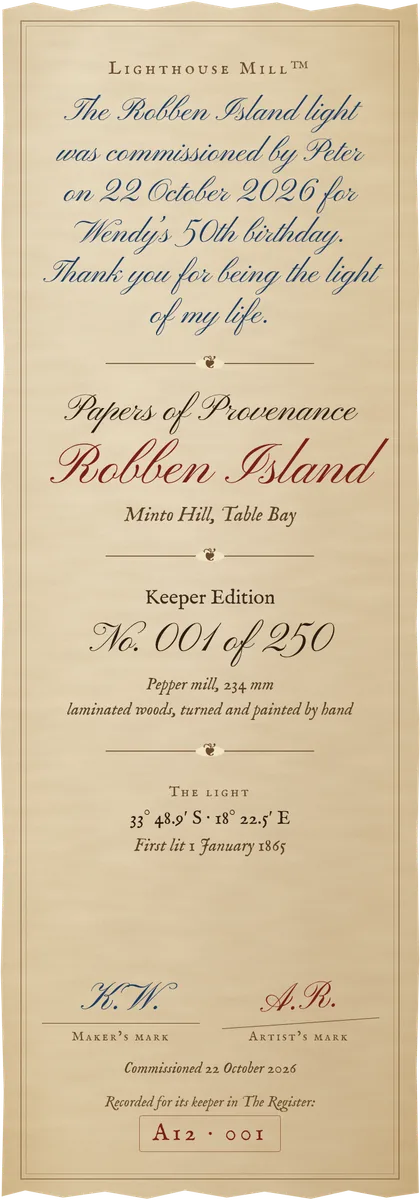
Every Lighthouse Mill™ is numbered, and every one comes with papers of its own: printed for your mill alone on textured paper, and signed by hand by the maker who turned it and the artist who painted it.
- The lighthouseand a short history of the light your mill honours
- Your numberin the edition, with the tier, and Salt or Pepper
- The makingthe woods and finish, any engraving, and the dates it was commissioned and finished
- Two signaturesthe maker’s and the artist’s, each signed by hand
- Its keeperyou, shown by name, by town, or as Private, with a message written by hand above or below the history, if you would like one
- A Register entryat the foot of the page, like a ledger: your number and its verification code
“The Robben Island light was commissioned by Peter on 22 October 2026 for Wendy’s 50th birthday. Thank you for being the light of my life.”
A gift that is truly one of a kind, or a lasting thank you from your business.

Made to be Opened Slowly
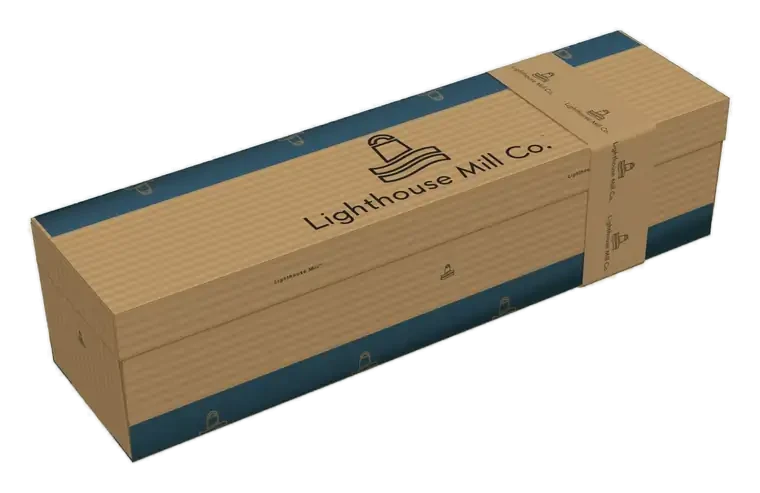
Every mill arrives in plain kraft, with its Papers of Provenance. Lift the lid and find your lighthouse resting in sea blue waves.
Simple, recyclable, made to keep.
Make it yours
Every mill carries the name of its lighthouse. You can add your own mark: a name, or even your logo, engraved into the wood. Choose your knob when you order, stainless steel or brass, and add a message to your Papers of Provenance.
Why lighthouses
The Book That Lit the Way
If there is one book every South African lighthouse lover should own, in our view this is it. Gerald Hoberman photographed the lighthouses and beacons of our coast, inside and out: the towers, the lanterns, the great lenses and the clockwork that turns them. It has been my guide (my lighthouse) since the first sketch of this collection, and its alphabetical list of lighthouses is the list our collection follows.
Hoberman is, by any measure, a pharophile. You do not climb that many spiral staircases with a camera unless you love what is at the top.
Where the Light Began
Alexandria, about 280 BCThe first great lighthouse stood on a small island called Pharos, at the mouth of the harbour of Alexandria in Egypt. It was commissioned under Ptolemy I and finished under his son Ptolemy II, and its design is credited to Sostratus of Cnidus. Ancient writers describe a tower in three stages: a square base, an octagonal middle and a round top, where a fire burned at night to guide ships past the shoals.
It is thought to have stood well over 100 metres tall, which made it one of the tallest buildings of the ancient world and one of its Seven Wonders. Earthquakes slowly brought it down, and by the fifteenth century its stones had gone into the Citadel of Qaitbay, which still stands on the same spot.
The island gave its name to the idea. That is why so many languages still call a lighthouse after Pharos:
- Phare, faro, farol, far
- The word for lighthouse in French; Italian and Spanish; Portuguese; Romanian.
- Pharology
- The study of lighthouses and signal lights. Its practitioners are pharologists.
- Pharophile
- Someone who simply loves lighthouses. No exam required.
- Pharophanalia
- My word for all the bits and pieces that come with a lighthouse obsession. See them here.
Not off a shelf. A piece of South Africa's coastline, for your table.
With special thanks to Thereza, whose request planted the seed.